|
February, 2024
Reprint
from FASNY
Dear FASNY Member:
The Federal
Occupational Safety
and Health
Administration
(OSHA) recently
proposed significant
changes to the OHSA
Fire Brigade
Standard (1910.156).
The new OSHA
1910.156 rule
(Emergency Response
Standard), if
approved in its
current form, will
dramatically change
the face of the fire
service in New York
and across the
nation. The
tumultuous impact
created by these
changes will be felt
by volunteer,
combination and
career departments
alike.
While the goal of
the new rule is to
further protect the
safety of emergency
responders, it was
crafted in a vacuum
and does not reflect
the challenges that
emergency response
agencies face in the
real world. While
the fire service
fully agrees that
responder safety is
of paramount
importance, that
goal must be
balanced with the
abilities and
resources of the
agencies responsible
for those
individuals. After
careful review, it
is apparent that
many of the changes
and new requirements
will negatively
impact already
struggling response
agencies. In fact,
the new standard
could hamper
recruitment and
retention efforts
and even cause many
current firefighters
to leave the
service. Despite its
bureaucratic “good
intentions”, this
new rule could
actually decrease
firefighter health
and safety.
The 608-page
document published
by OSHA contains
data and stories as
to why the changes
are needed. Based on
our real-world
experience, we
question the
reliability of some
of the data and
theories used to
produce this
proposal. Rather,
there are less
intrusive actions
that fire service
organizations could
take that would have
immediate positive
impacts on
firefighter safety
and create little or
no additional
burdens. Several of
these areas have
been untouched by
the proposed
standard, while
costly and
time-consuming
requirements have
made their way into
the proposed
regulation.
Twenty-two National
Fire Protection
Association (NFPA)
standards have been
fully incorporated
into the new OSHA
standard by
reference, with
another fourteen
included in part.
This means that
anyplace the NFPA
standard says
“shall” or “must”
the AHJ would be
responsible to
adhere to them.
These changes will
have major
implications on
every AHJ, fire
officer and
firefighter. Our
concern here is not
merely that they are
unfunded mandates.
It is the fact that
it will place
increased liability
on organizations
especially if they
suffer a firefighter
injury or death. The
unattainable nature
of this proposed
standard virtually
ensures fines and
litigation at a
level we have never
seen.
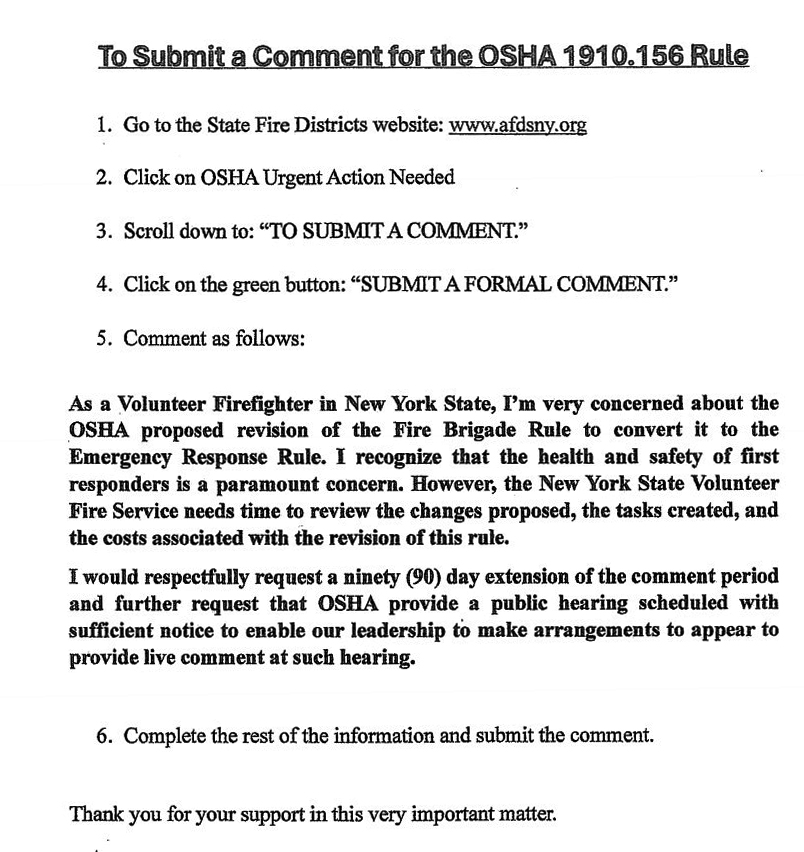
The proposed changes
have been published
in the Federal
Register and are
currently in a
90-day comment
period that
concludes on May 6.
The fire service
must be united in
their response to
this potentially
devastating
governmental action.
This includes
involvement by your
fire service
organization. We
need you to inform
your department of
this situation and
ask them to request
that the comment
period be extended
for an additional 60
days. They should
also request that
OSHA hold an “in
person” hearing
where testimony can
be presented.
Further, every AHJ
should review the
proposed rulemaking
and submit comments
on how it would
negatively impact
their organization.
The importance of
immediate action by
every AHJ cannot be
overstated.
Fraternally,
President
|